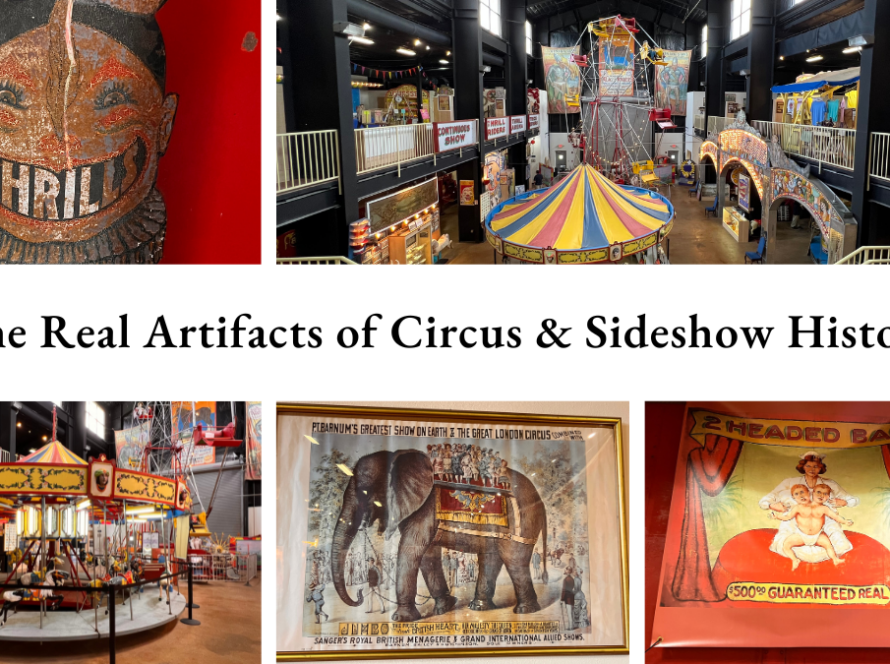
There is a detail in Freak that has stayed with me since I wrote it — a braided cord sitting in a museum display case, catalogued as circus memorabilia, that turns out to be something else entirely. Ronan recognizes it first: an old inventory system, fae-trading era, used to track what was being moved without officially naming it. It looks decorative. It is not. That detail did not come from nowhere. It came from the real and largely underexamined history of how the sideshow economy actually worked — not just on the stage, but behind it. On my blog this month, I went deep into the shadow market that operated beneath the spectacle: the scouts, the brokers, the curators who moved unusual human beings between shows the way other men moved livestock, the contracts signed by parents over the heads of children who had no say, the ledgers that described performers in the language of inventory rather than employment. It is uncomfortable history. It is also the history that gave me the Curator.
What makes this history genuinely complicated — and what I found most useful as a writer — is that it refuses a simple villain. The same institution that trafficked and exploited also served, for many performers, as the only sanctuary available to them. Circuses created found families in a world that had no other place for people society had decided were too strange to exist in public. Some brokers began as something close to advocates and became something else over decades of transactions and rationalizations, the line between placing someone in safety and placing them in a collection growing blurrier with every deal. That arc — the slow corruption of someone who started with good intentions — is the story of Silas. And it is a very old story, rooted in a history that is far more real than fiction.
The full essay is below, and it goes into specifics: the real cases, the real contracts, the real records that read like something out of a fae trafficking ledger because in some ways that is exactly what they were. If you have read Freak, you will find the history illuminating. If you have not read it yet — well. The braided cord is waiting.
— ✦ —
Behind the Banners: The Dark Trade That Hid Inside the Sideshow
When we picture the golden age of the American circus, we picture wonder. The torchlit procession rolling into town, the calliope shrieking joy down main street, the banners billowing outside the sideshow tent with their painted promises of miracles inside. That image is real — and it is also exactly what it was designed to be. Because what the banners were very deliberately crafted to prevent you from picturing was the machinery behind the spectacle. The networks of scouts and brokers and managers who moved human beings between shows the way other men moved livestock. The contracts signed by parents on behalf of children who had no voice in the matter. The performers who went to sleep in one city and woke up owned by someone else.
The sideshow was a business. And like any business built on scarcity and spectacle, it generated a shadow economy — one in which people who were considered rare enough to exhibit were also, all too often, considered rare enough to sell.
The Market for Oddities
Sideshows emerged as organized entertainment in 16th-century England, where businessmen began scouting people with unusual physical characteristics and shuttling them across Europe for paying audiences. By the 19th century, the practice had exploded into a full industry, with competing promoters and showmen hunting the same shrinking pool of what the trade called “human oddities.” The golden age of the sideshow — roughly 1840 to 1940 — was a genuine cultural phenomenon, and it was fueled, in no small part, by ferocious competition for the rarest talent.
That competition created a marketplace. And like any marketplace where the commodity is rare and the buyers have deep pockets, it attracted intermediaries: agents, scouts, brokers, and what the industry sometimes called curators — men who specialized in identifying, locating, and acquiring unusual performers for the shows that wanted them. The most accomplished of these operators developed reputations that preceded them into every city. A circus owner who needed a specific kind of act knew who to send a letter to. And that person, more often than not, could deliver.
What they were delivering was a human being. Sometimes a willing one. Often not.
Sold by the People Who Should Have Protected Them
Here is the thing about the sideshow’s darkest history: the most disturbing chapter does not take place inside the tent. It takes place before the performer ever arrives there. Some of the most famous and heartbreaking stories in all of sideshow lore begin not with a villainous stranger but with a family transaction.
Millie and Christine McKoy were conjoined twins born into slavery in 1851. Their enslaver sold them to a showman when they were eight months old — along with their mother — for one thousand dollars. Within the year, they were sold again. They passed through multiple owners before eventually regaining some measure of autonomy, and they became celebrated, canny performers who negotiated their own contracts as adults. But they began as property, transferred by bill of sale before they were old enough to walk.
Annie Jones — the celebrated Bearded Lady who became one of P.T. Barnum’s most recognizable stars — began her sideshow career before she turned one year old. Her parents signed a contract with Barnum when she was still an infant. She was so valuable to competing showmen that she was kidnapped as a small child by a rival exhibitor who simply wanted her for his own museum. The people most responsible for her safety treated her, instead, as an asset worth stealing.
These were not aberrations. Across the industry, disabled children, children born into poverty, and children whose families had no other economic path were signed into the sideshow world by the very adults who should have been their advocates. Some managers were scrupulous and genuinely kind — there are warm accounts of that too, and we will get there. But others ran their performers through ten to fifteen shows a day, shuttled them city to city on a grinding circuit, and paid them a fraction of the revenue they generated. The power imbalance was not incidental. It was structural — built into the contracts, into the ownership of performers’ images and stories, into the cold arithmetic of a world that had very few doors open to people who looked the way these performers looked.
The Cataloguing System: When People Became Inventory
Behind the glamour of the big top, there was paperwork. Detailed, meticulous, chilling paperwork. Promoters and agents maintained ledgers of their performers — physical descriptions, abilities, contract terms, current location, full acquisition history. The language of these records was not the language of employment. Acts were “obtained,” “secured,” “transferred.” The shows they moved between were described in terms of their capacity to hold and display. If you did not know what you were reading, you might think it was a catalog of rare books.
This cataloguing ran deepest in the trade that operated outside the legitimate circus world entirely — the private collectors, the wealthy exhibitors who kept personal exhibitions in their estates, and the brokers who served both the public shows and the private market simultaneously. For someone who moved in these circles, a performer with an extraordinary or entirely unique characteristic was not merely an attraction. They were a specimen. And specimens, in that world, came with provenance records.
What is striking, when you look closely at this shadow market, is how faithfully it mirrors other trafficking economies of the same era — the language of acquisition, the intermediaries who maintain careful distance from the act of coercion, the way legitimate commerce and outright exploitation ran on the same infrastructure and through the same hands. A broker who placed a performer in a well-run circus with fair wages was using the same networks and the same contacts as one who placed a performer somewhere far darker. The ledger looked the same either way.
The Idea of Sanctuary
Here is where the history gets genuinely complicated, and it would be dishonest to skip past it: not every circus was a trap. This is the part that tends to vanish when we reckon with the sideshow’s worst chapters, and it matters enough to say plainly.
For many performers — particularly those with visible disabilities or physical differences that made ordinary employment impossible and ordinary public life actively hostile — the traveling circus was one of the only places in the world where they were not just tolerated but celebrated. Performers describe poker games between acts with people who had three legs and faces covered in hair. They married, had children, and built lives on the road with people who understood exactly what it meant to be stared at, because everyone around them did too. Harry Doll, a performer with dwarfism who worked for Ringling Bros., reportedly told a nervous newcomer that there were more freaks in the audience than in the show. He was not wrong, and he was not being cruel. He was handing over the most useful piece of knowledge he had.
The protection was sometimes literal. So-called “ugly laws” in the United States, beginning in the 1860s, actually banned people with visible deformities from appearing in public — but specifically exempted exhibitions. Being part of a traveling show was, for some performers, the legal difference between existing in public and not being permitted to.
The tension between the circus as exploitation and the circus as refuge is real and unresolved, and it should stay that way. Both things were true at once. The same institution could be a lifeline for one performer and a trap for another, depending entirely on who was running it and what their intentions were. That ambiguity is not a weakness in the history. It is the most honest thing about it.
The Curator’s Shadow: How a Fixer Becomes a Collector
The most morally interesting figure in the shadow economy of the sideshow was not the obvious villain — the abusive small-time operator, the enslaver who sold a child for a thousand dollars. Those people are easy to condemn. The harder figure is the broker — the curator — who began with something close to good intentions and evolved, across enough time and enough transactions, into something unrecognizable.
Consider the internal logic of such a person. In the early days of the sideshow trade, someone who specialized in identifying and placing unusual performers could genuinely believe they were providing a service: finding people who had no safe options and connecting them with shows that would pay fairly, offer community, and give them a kind of visibility that the outside world denied them. The circus as sanctuary, and the broker as the one who knew where the door was. For a certain kind of person, in a certain era, this self-image could have been entirely sincere — and almost certainly was, at first.
But markets shift. The well-run shows get harder to find. The performers who were once being placed into warm communities are now being placed into situations the broker prefers not to examine too closely. The fees are better when the buyer is less scrupulous, and the work is exactly the same — identify, locate, acquire, deliver. The broker has always been good at the work. And so the justifications arrive quietly, one at a time: they were going to end up somewhere regardless. At least with me, they arrive intact. I know where they are. I haven’t lost anyone yet.
This is the anatomy of corruption that doesn’t feel like corruption from the inside — because each individual step is small, and the rationalizations are always ready, and by the time the broker’s ledger begins to look less like employment records and more like a collection catalog, they have long since stopped noticing the difference.
Why This History Still Matters
The sideshow has been absent from mainstream American entertainment for decades. The explicit market for human oddities — the scouts, the brokers, the acquisition records — belongs to another century. And yet the patterns it established show up, reliably, in almost every entertainment industry that has followed it.
The talent agent who signs a child performer on terms the parents don’t fully read. The manager who controls the contract, the schedule, the image, and the money. The scout who finds vulnerable people in desperate circumstances and offers them a door that turns out to open onto a very small room. The collector who curates not just art and artifacts but human beings — their stories, their appearances, their most extraordinary characteristics — and places them on display for an audience that pays to look. These are not relics. They are recognizable.
The circus did not invent any of this. It inherited it from older traditions and passed it forward into newer ones. What it did, perhaps more vividly than almost any institution before or since, was make the machinery visible. The sideshow put the transaction right there on the midway, under the same banner as the acrobats and the tigers, and charged you a dime to walk in and look.
The question it never quite answered — the one it kept deferring with spectacle and showmanship — was whether the people inside were there by choice, and whether the people outside were really paying for wonder. That question does not have a single answer. It has several, all of them true at once, and that is what makes this history so difficult and so necessary to sit with.
The braided cord. The ivory tokens. The iron ring. Someone catalogued what moved through the world, in a system built to track without naming. The language of inventory, applied to lives.
The sideshow called it a collection. History calls it what it was.